
Your debt-to-income ratio has zero effect on your credit score. FICO and VantageScore don’t know what you earn, so they can’t calculate DTI. That part is true, and it’s where most articles on this topic stop.
But the relationship runs the other direction. When a lender calculates your DTI, they pull your monthly debt obligations directly from your credit report. The minimum payments on your credit cards, the monthly payments on your installment loans, the balances that determine fallback calculations when a payment field is blank. All of it comes from the same credit report data that generates your score.

This means a credit report error can hurt you twice. Once in your score, because a wrong balance inflates your utilization ratio. And again in your DTI, because the same wrong balance inflates the minimum payment your lender counts against your income. Two systems, same bad data, two penalties. And fixing the report error corrects both at once.
Why Your Credit Score Can’t See Your DTI
A lot of people assume that carrying a high debt load relative to their income drags down their credit score. It makes intuitive sense, but the scoring models don’t work that way.
What Goes Into a Credit Score (And What Doesn’t)
FICO scores are built from five categories of credit report data: payment history (35%), amounts owed (30%), length of credit history (15%), new credit (10%), and credit mix (10%). Every input comes from the credit report. Income, employment status, job title, salary, DTI — none of it is in that data. The credit bureaus don’t collect income information. The scoring models can’t use what they don’t have.
This is why two people with identical credit reports but very different incomes will have the exact same FICO score. The model sees the same data and produces the same output. DTI is invisible to it.
Why This Confuses People
The confusion usually comes from mixing up utilization and DTI. They sound similar but measure completely different things.
Utilization compares your revolving balances to your credit limits. It’s calculated from credit report data, it’s part of your score, and it falls under the “amounts owed” category (30% of FICO). A $3,000 balance on a $10,000 limit is 30% utilization.
DTI compares your total monthly debt payments to your gross monthly income. It’s calculated by your lender using income documentation and credit report payment data. It affects your loan approval. It has nothing to do with your score.
They share one thing in common: both can be affected by the same credit report error. But that’s the only overlap, and it’s the part nobody talks about.
How Your Lender Actually Calculates DTI
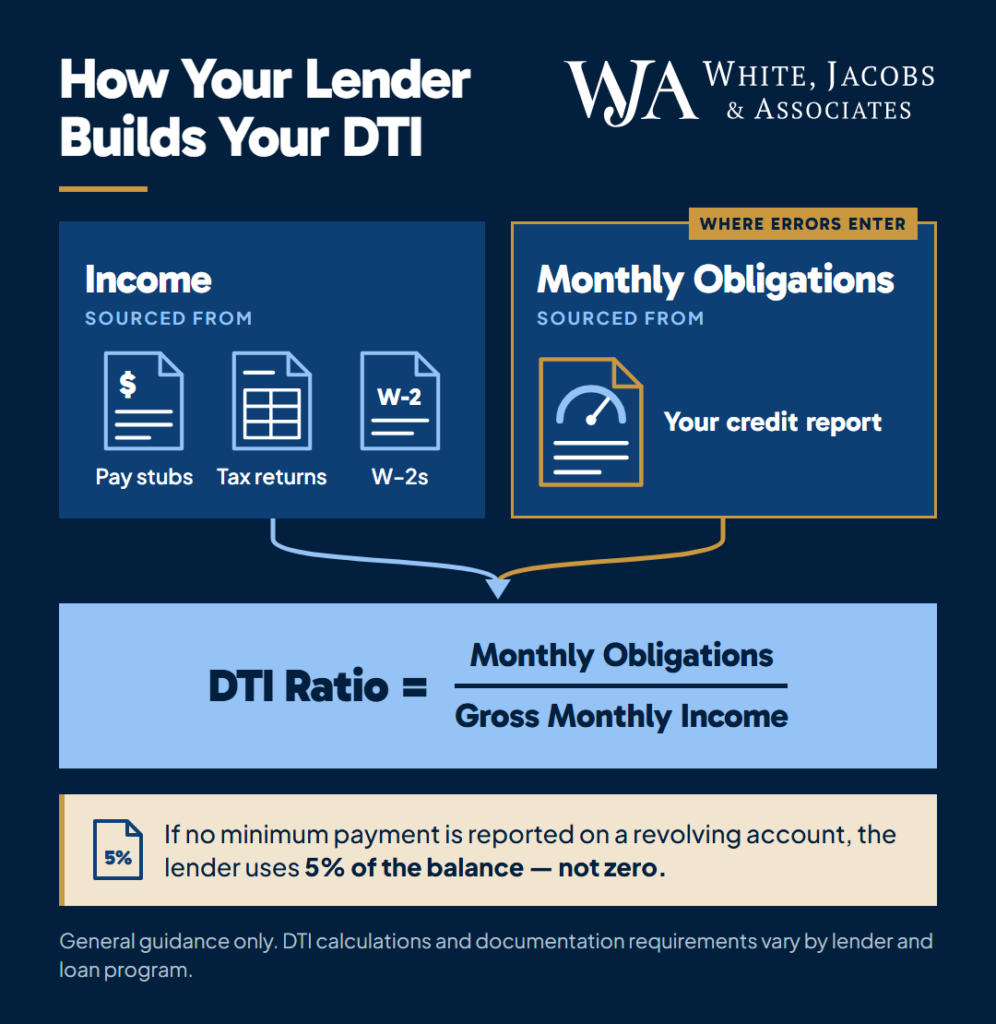
When you apply for a mortgage, auto loan, or personal loan, the lender runs a DTI calculation. The formula itself is simple: total monthly debt obligations divided by gross monthly income. What most people don’t realize is where each half of that equation comes from.
The Two Inputs: Income and Monthly Obligations
Income is verified through pay stubs, tax returns, W-2s, and in some cases bank statements or profit-and-loss statements for self-employed borrowers. This side of the equation comes from you and your employer.
Monthly obligations are pulled from your credit report. The lender’s underwriting system reads the tradelines on your report and totals up the monthly payments: minimum payments on revolving accounts, monthly payments on installment loans, and any other recurring obligations that appear on your file. This side of the equation comes from the data your creditors have reported to the bureaus.
The lender divides the second number by the first. The result is your DTI.
Where the Monthly Payment Numbers Come From
Under Fannie Mae’s selling guide (B3-6-05), the lender uses the monthly payment shown on the credit report for revolving accounts and installment loans. FHA guidelines in HUD Handbook 4000.1 say the same: “The Mortgagee must include the monthly payment shown on the credit report, loan agreement or payment statement.” Freddie Mac follows the same structure.
The credit report is the primary data source. If the payment on the report matches reality, the DTI calculation is accurate. If the payment on the report is wrong, the DTI calculation is wrong.
The 5% Fallback Rule
When a revolving account on your credit report shows a balance but no minimum payment, the lender doesn’t use zero. Fannie Mae requires the lender to use 5% of the outstanding balance as the monthly obligation. Desktop Underwriter specifically uses the greater of $10 or 5%.
This is where a missing data field can create a serious problem. Say you have a HELOC with a $10,000 balance and a $50 actual minimum payment, but the creditor didn’t report the minimum payment to the bureaus. Instead of $50/month in your DTI, the lender uses 5% of $10,000: $500/month. That one blank field just added $450 to your monthly obligations on paper.
For FHA loans, the fallback on deferred or unavailable installment debt payments is also 5% of the outstanding balance. Student loans with no available payment use 0.5% of the outstanding balance under current FHA rules (per Mortgagee Letter 2021-13), which is lower than the revolving fallback but can still be significant on a large loan balance.
The Five Credit Report Errors That Inflate Your DTI
These are the specific situations where inaccurate credit report data creates a DTI problem your lender will act on as if it’s real.
Wrong Balance on a Revolving Account
A creditor reports a $4,000 balance on a card where you’ve already paid it down to $1,500. If your minimum payment is being calculated from that balance (either directly or through the 5% fallback), the lender is counting a higher monthly obligation than what actually exists.
Under the 5% fallback: $4,000 generates a $200/month payment. The actual $1,500 balance generates $75/month. That’s $125/month of phantom debt in your DTI. On a $6,000 gross monthly income, that’s a 2-point swing in your DTI ratio. Near a program threshold, that swing can determine approval or denial.
Missing Minimum Payment Field
This is the most common version of the problem, and most consumers don’t know it’s happening because you can’t see the “minimum payment” field when you pull your own report through the standard consumer channels.
When the field is blank, the 5% fallback kicks in. A $15,000 credit card balance with a $300 actual minimum payment but no reported minimum becomes $750/month in DTI. A $20,000 HELOC with a $100 interest-only payment becomes $1,000/month. The gap between reality and what the lender uses can be enormous, and it all comes from one empty data field.
Closed Account Still Reporting a Balance
You paid off a credit card and the account is closed. But the creditor hasn’t updated the tradeline, or the update hasn’t reached all three bureaus yet. The lender sees an open balance, calculates a minimum payment from it, and counts it in your DTI.
The debt is paid and the account is closed, but on paper your DTI still carries the weight of that balance.
Duplicate Reporting on the Same Debt
If a debt was charged off by the original creditor and then sold to a collection agency, both entities may report the same debt with a balance. The original tradeline shows a charge-off balance. The collection tradeline shows the same amount (or a different amount with fees added).
The lender’s system may count both minimum payments, even though they represent the same underlying obligation. Same debt, potentially double the DTI impact. For a deeper look at which of these entries are disputable, our guide on what can actually be removed from your credit report covers the full picture.
Co-Signed Loan Reporting Issues
A co-signed loan counts toward your DTI in full unless the primary borrower can document 12 consecutive months of on-time payments with no late payments and no cash payments. If the co-signed tradeline reports inaccurate payment history (showing a missed payment that was actually made on time, for example), that inaccuracy can block the exclusion even when the primary borrower has been paying consistently.
This means an inaccurate tradeline on a co-signed account doesn’t just affect your score. It can prevent the DTI exclusion that would have kept that loan’s payment out of your ratio entirely. We covered the full scope of how co-signed loan defaults affect your credit report in a separate article.
The Double Hit: How One Error Penalizes You Twice
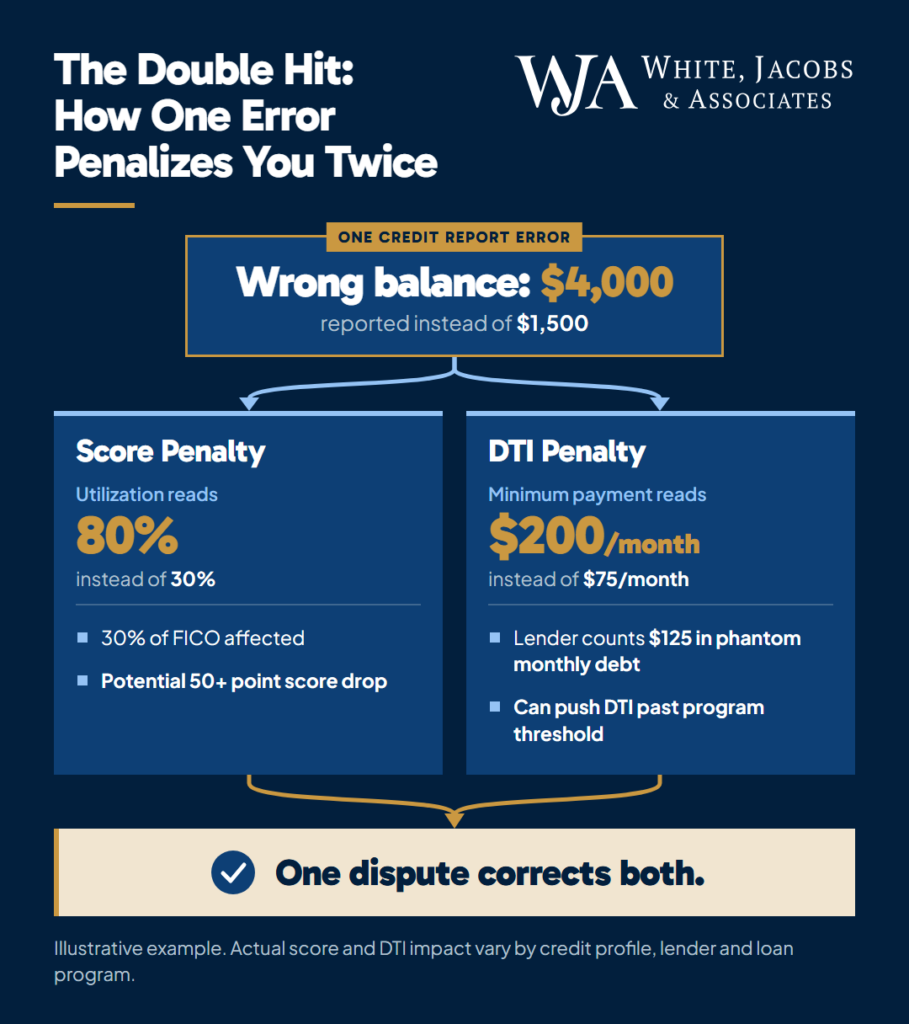
This is the concept that ties the whole article together. A single credit report inaccuracy can damage both your credit score and your DTI through two completely different mechanisms.
The Score Penalty
A wrong balance inflates your credit utilization ratio. Utilization, the percentage of your available revolving credit that you’re using, makes up 30% of your FICO score. It’s the second most important factor after payment history.
If a card with a $5,000 limit reports a $4,000 balance instead of the actual $1,500, your utilization on that card reads as 80% instead of 30%. Across your full credit profile, that difference can cost you 50 points or more depending on your other accounts. And those points directly affect the pricing tier your lender assigns, which determines your interest rate.
The DTI Penalty
The same wrong $4,000 balance inflates the minimum payment your lender uses in the DTI calculation. If the 5% fallback applies, the lender counts $200/month instead of $75/month. On a $6,000 gross monthly income, that’s the difference between a 1.25% and a 3.3% contribution to your DTI from that one account alone.
Near a program threshold (50% for conventional, 41% for USDA), that swing can be the difference between a clean approval and a denial or a manual underwriting downgrade.
Fix the Report, Fix Both Numbers
Correcting the reported balance fixes utilization and DTI in one move. The dispute targets the same tradeline, the same creditor, the same inaccuracy. The bureau investigates one item, the creditor corrects one balance, and both systems receive accurate data.
This is where a detailed review of what’s on the credit report, not just the score-affecting items but the payment data feeding into lender calculations, can change the outcome of a loan application. You can learn more about how our review process works.
DTI Thresholds by Loan Program
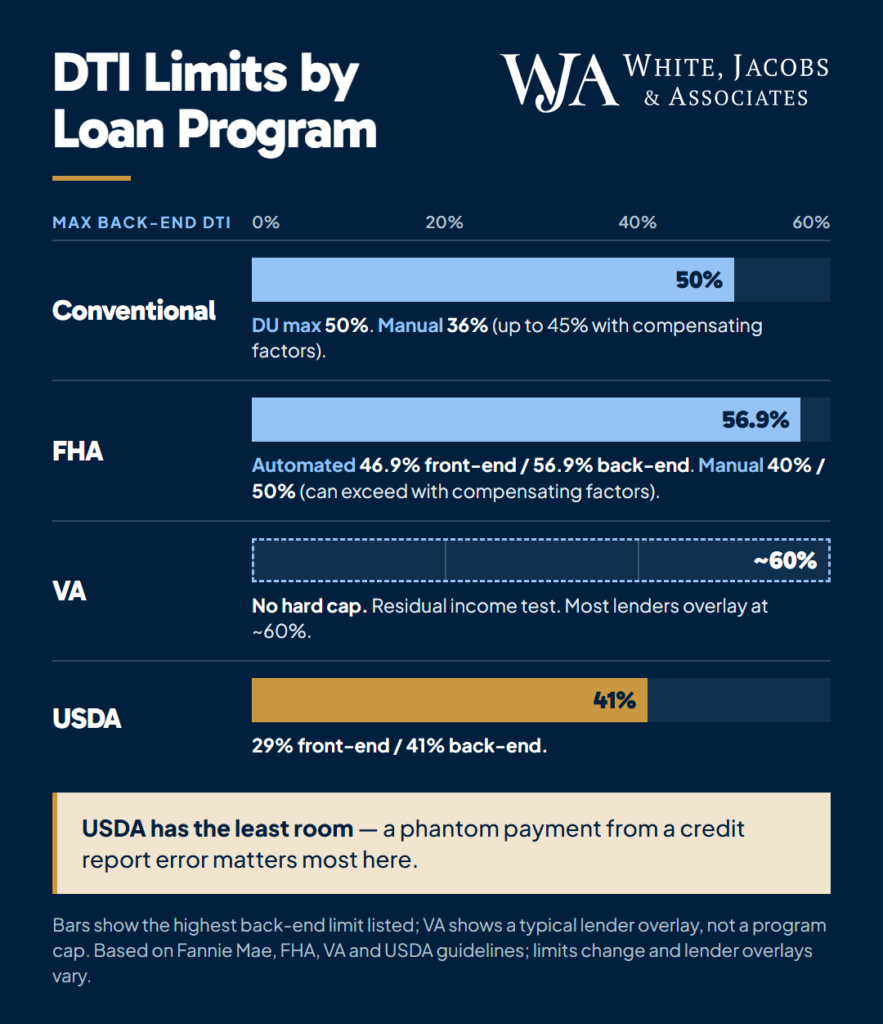
Different loan programs have different DTI limits. Knowing where the thresholds are helps you understand how much room you have and how much an inflated payment matters.
Conventional Loans
Fannie Mae’s Desktop Underwriter allows a maximum DTI of 50%. Manual underwriting caps at 36%, which can be extended to 45% with compensating factors like cash reserves, a strong credit score, or a low housing-expense ratio. Most conventional borrowers go through DU, so 50% is the practical ceiling for most applicants.
FHA Loans
FHA’s automated underwriting system (TOTAL Scorecard) allows a maximum back-end DTI of 56.9% and a front-end of 46.9%. Manual underwriting caps at 40% front-end and 50% back-end, with room to exceed if the borrower has compensating factors: 12 months of documented rent history, cash reserves, a larger down payment, or stable employment.
FHA’s higher limits give borrowers more room, but they also mean the program already accounts for higher debt loads. An inflated payment from a credit report error eats into that room the same way it would on a conventional loan.
VA Loans
VA loans have no hard DTI cap. Instead, they use a residual income test that measures how much money the borrower has left after all obligations are paid. If the residual income meets the VA’s threshold for the borrower’s family size and region, a high DTI alone won’t cause a denial.
That said, most lenders impose their own overlay, typically around 60% DTI. And even with the residual income test, inflated payments from credit report errors still reduce the residual income number, which can push a marginal file into denial territory.
USDA Loans
USDA has the tightest limits: 29% front-end and 41% back-end. There’s very little room for error. A phantom $200/month payment from an inaccurate balance or a missing minimum payment field can push a USDA borrower over the 41% threshold when they’d otherwise qualify.
What You Can and Can’t Fix Through Credit Repair
What’s Fixable
Wrong balances, missing payment fields, closed accounts still reporting open balances, duplicate tradelines from the same underlying debt, and co-signed loan reporting inaccuracies that prevent DTI exclusion. All of these are disputable under the FCRA, and all of them directly affect the DTI calculation your lender runs.
The dispute process for DTI-related items works the same way as any other credit report dispute. You identify the inaccuracy, file with the bureau and the furnisher, and the bureau has 30 days to investigate (extendable to 45 with supplemental documentation). If the item can’t be verified as accurate, it must be corrected or removed.
If you’re on a mortgage timeline, the sequencing of when to dispute and when to stop matters. Getting the dispute resolved before the lender pulls your credit is what makes the correction count.
What Isn’t Fixable Through Disputes
Legitimate debts with accurate reporting count toward DTI and can’t be disputed away. A car payment you’re making every month, a student loan with a correct balance, a credit card with an accurate minimum payment on your statement — those are real obligations and they stay in the calculation.
Low income relative to your obligations is an income problem, not a credit report problem. Credit repair can fix what’s inaccurate on the report. It can’t change what’s accurate, and it can’t increase your income. If your DTI is high because you genuinely owe a lot relative to what you earn, the path forward is either increasing income, paying down debt, or finding a loan program with a higher DTI threshold.
Common Questions
Does my DTI affect my credit score?
No. Credit scoring models don’t factor in income, employment, or DTI. Your score is calculated entirely from credit report data: payment history, balances, account ages, inquiries, and credit mix. DTI is a lender-side calculation that affects your loan approval, not your score.
How do I know if my credit report is inflating my DTI?
Pull your reports from all three bureaus at AnnualCreditReport.com. For each account, compare the reported balance and minimum payment to your most recent statement from that creditor. If any balances are wrong, any minimum payments are missing, or any paid-off accounts still show a balance, your lender’s DTI calculation will be higher than it should be.
The tricky part is that the standard consumer credit report may not display the minimum payment field the same way a lender’s tri-merge report does. If you’re not sure whether a missing field is causing a fallback calculation, a credit analyst can help you read the report the way a lender would.
Will paying down a credit card lower my DTI?
Yes, if the lower balance reports to the bureaus before your lender pulls your credit. Creditors report once per billing cycle, usually around your statement closing date. Time the paydown before the closing date so the lower balance (and lower minimum payment) appears on your credit report when the lender sees it.
If the timing is tight, your lender may be able to use a rapid rescore to update the report in 2-5 business days with documentation of the paydown. But the paydown has to happen first, and the creditor has to have processed it.
Can I dispute a correct balance that’s hurting my DTI?
No. Disputes are for inaccurate, incomplete, or unverifiable information. If the balance on your credit report matches your most recent statement, the reporting is accurate and there’s no basis for a dispute. If the balance is correct but you want to lower your DTI, that’s a paydown strategy, not a credit repair question.
Do utilization and DTI measure the same thing?
No. Utilization compares your revolving balances to your credit limits. It’s a credit report calculation that affects your score. DTI compares your total monthly debt payments to your gross monthly income. It’s a lender calculation that affects your approval. They use different inputs, different denominators, and affect different outcomes. The one thing they share: both can be distorted by the same credit report error, which is why fixing that error corrects both numbers at once.
Check the Data Before You Check the Math
Most people who are told their DTI is too high immediately start thinking about how to earn more money or which debt to pay off first. Those are real options. But before you pick up a side job or drain your savings paying down balances, check whether the numbers your lender is using are actually right.
A wrong balance, a missing payment field, or a duplicate tradeline can inflate your DTI with data you can challenge and fix. And because the same error often inflates your utilization ratio at the same time, correcting it can move both your score and your DTI in the right direction with a single dispute.
When our analysts pull a client’s report, the DTI-related items are part of what they review. Not just the entries that affect the score, but the payment data that lenders will use to build their DTI calculation. Getting both sides of the report right is what gives you the clearest picture of where you stand before you apply.
Book a free consultation. We’re easy to talk to.