
Credit repair can help you qualify for a better mortgage rate, a lower down payment, or approval you wouldn’t get otherwise. But the timing matters more than most people realize. If you’re actively disputing items on your credit report when a mortgage lender pulls your file, those disputes can freeze your application, trigger a manual underwriting downgrade, or force you to withdraw the disputes, which can actually drop your score.
Most of the advice online says “fix your credit, then apply for a mortgage.” That’s the right idea without enough detail. The real question is what to fix, when to fix it, and what to leave alone once the mortgage process starts. Getting that sequence wrong can cost you weeks, thousands of dollars, or the deal itself.

Our analysts work with mortgage-track clients regularly, and many of them start the process 3 to 6 months before they want to apply. The first conversation is always about when they want to apply and what the credit report looks like right now. That timeline shapes every decision: what to dispute, how to structure the rounds, and when to stop so the report is clean before the lender pulls it. And the biggest risk isn’t having bad credit. It’s doing the right credit work at the wrong time.
What Happens When Active Disputes Meet a Mortgage Application
This is the part nobody warns you about. You’ve been working on your credit, you’ve filed disputes on inaccurate items, and things are moving in the right direction. Then you apply for a mortgage, and the disputes on your report create a problem the lender has to deal with before your file can move forward.
How Disputed Accounts Affect Underwriting
When a tradeline on your credit report carries an active “in dispute” notation, mortgage underwriting treats it differently than a clean tradeline. The specifics depend on the loan type, but the general pattern is the same: disputed accounts introduce uncertainty that underwriters have to resolve before they can approve the file.
The issue is that a disputed account’s scoring impact is unclear. While a dispute is active, the credit bureaus may temporarily exclude that account from the score calculation. That means the score your lender sees may not reflect what the score would be once the dispute is resolved and the account re-enters scoring. Underwriters need to know the real number, not a temporary one.
FHA Loans and the $1,000 Dispute Threshold
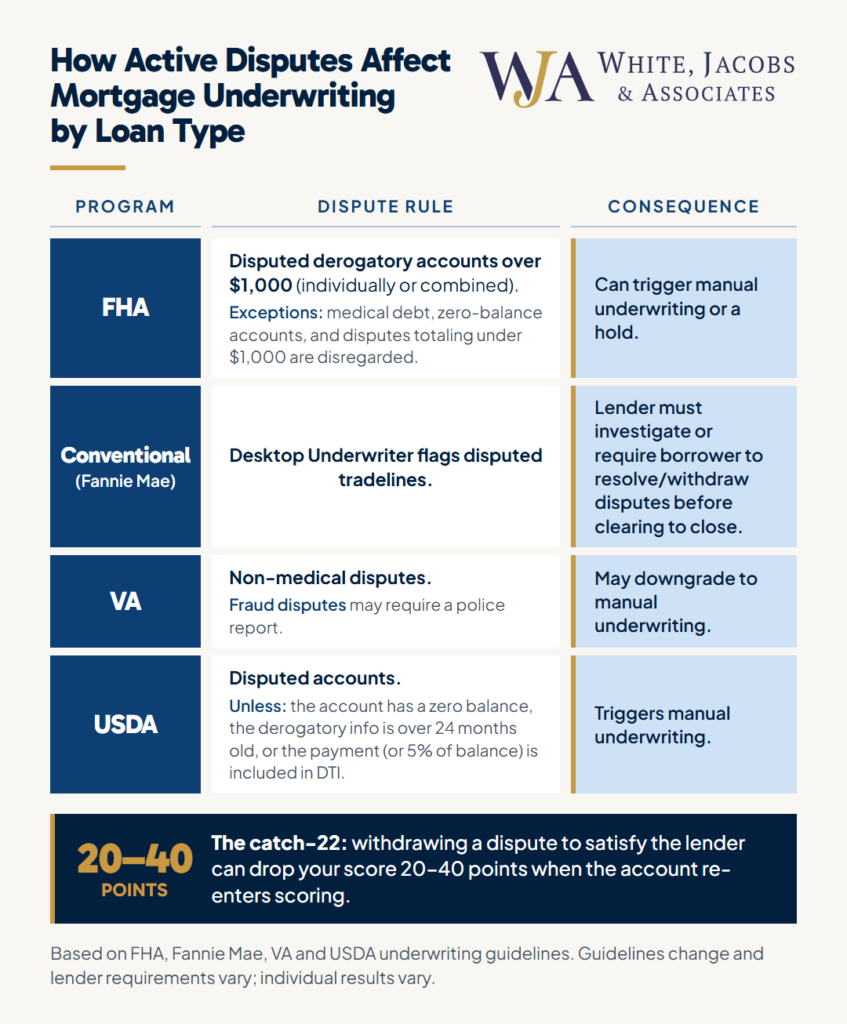
FHA guidelines treat disputed derogatory accounts with balances over $1,000 (individually or combined) as a red flag. When these appear on a borrower’s report, the lender may be required to downgrade the file to manual underwriting or hold the application until the disputes are resolved.
There are exceptions. Medical debt disputes are generally disregarded. So are disputes on accounts with a zero balance and disputes where the total disputed amount is under $1,000. But if you have a disputed collection for $1,200, that’s enough to trigger the hold, even if the dispute is legitimate and the reporting is inaccurate.
Conventional Loans and Automated Underwriting
For conventional loans backed by Fannie Mae, the automated underwriting system (Desktop Underwriter) flags disputed tradelines and may require the lender to investigate whether they affect the borrower’s creditworthiness. If DU sees disputed accounts on the report, the lender has to determine whether those disputes materially change the risk profile.
In practice, most lenders take the simplest path: they ask the borrower to resolve or withdraw the disputes before they’ll clear the file to close. Some lenders will work through the investigation themselves, but that takes time and documentation. Either way, disputed tradelines on a conventional file create friction that can delay closing.
The Catch-22 of Removing a Dispute
This is where it gets painful. The bureaus often exclude disputed accounts from the scoring calculation while the dispute is active. That exclusion can make your score look higher than it would be with the account fully factored in.
When you withdraw the dispute to satisfy the lender, the account re-enters scoring and your number can drop. If the disputed account was a collection or a charge-off, that drop can be significant. We’ve seen borrowers in the low 600s with a dispute active lose 20 to 40 points once the account re-enters scoring, pushing them below program minimums (620 for conventional, 580 for FHA with 3.5% down).
This catch-22 is the reason timing matters so much. If the disputes had been resolved months earlier, the score would have already adjusted and stabilized. The borrower would know their real number before walking into the lender’s office.
Why the Score on Your Phone Won’t Match What Your Lender Pulls
Before you start planning your mortgage around a credit score, make sure you’re looking at the right one.
Mortgage Lenders Use Different Scoring Models
Mortgage lenders don’t use the score you see on Credit Karma, and they don’t use the FICO 8 from the Experian app. They pull a tri-merge report and use three specific FICO versions: FICO 2 (Experian), FICO 4 (TransUnion), and FICO 5 (Equifax). Your qualification and pricing are based on the middle score of the three.
These are older, stricter models than what free apps show. The gap between your VantageScore and your mortgage FICO can be 40 to 80 points, depending on your credit profile. We walk through exactly why your credit score is different everywhere you check in a separate breakdown, but the short version is: don’t plan your mortgage around your Credit Karma number.
What That Gap Means for Your Rate
Mortgage pricing isn’t a smooth curve. Lenders use loan-level price adjustments that change at specific score boundaries: 780, 760, 740, 720, 700, 680, 660, 640, 620. Each boundary shift changes your rate, your points, or both.
On a $350,000 mortgage, the difference between one pricing tier and the next can cost tens of thousands of dollars over 30 years. A VantageScore of 720 that translates to a mortgage FICO of 680 doesn’t just mean a slightly different rate. It can mean a completely different tier. Our article on credit score pricing tiers walks through the dollar impact at each level.
The Right Sequence: What to Fix and When
The timeline for credit repair before a mortgage depends on whether you’re managing the process yourself or working with a firm that structures the work around your application date. The risks described above (frozen files, score drops from withdrawn disputes) come from unmanaged disputes, where someone files challenges without a closing date in mind and those disputes are still active when the lender pulls the report.
A managed credit repair process that starts 3 to 6 months before a mortgage application can work, as long as the rounds are structured to resolve before the application begins. That’s exactly what our process is built for. The Investigative Research team knows when the client wants to apply and sequences the work so disputes close out cleanly before the lender pulls the file.
Here’s how the timeline breaks down.
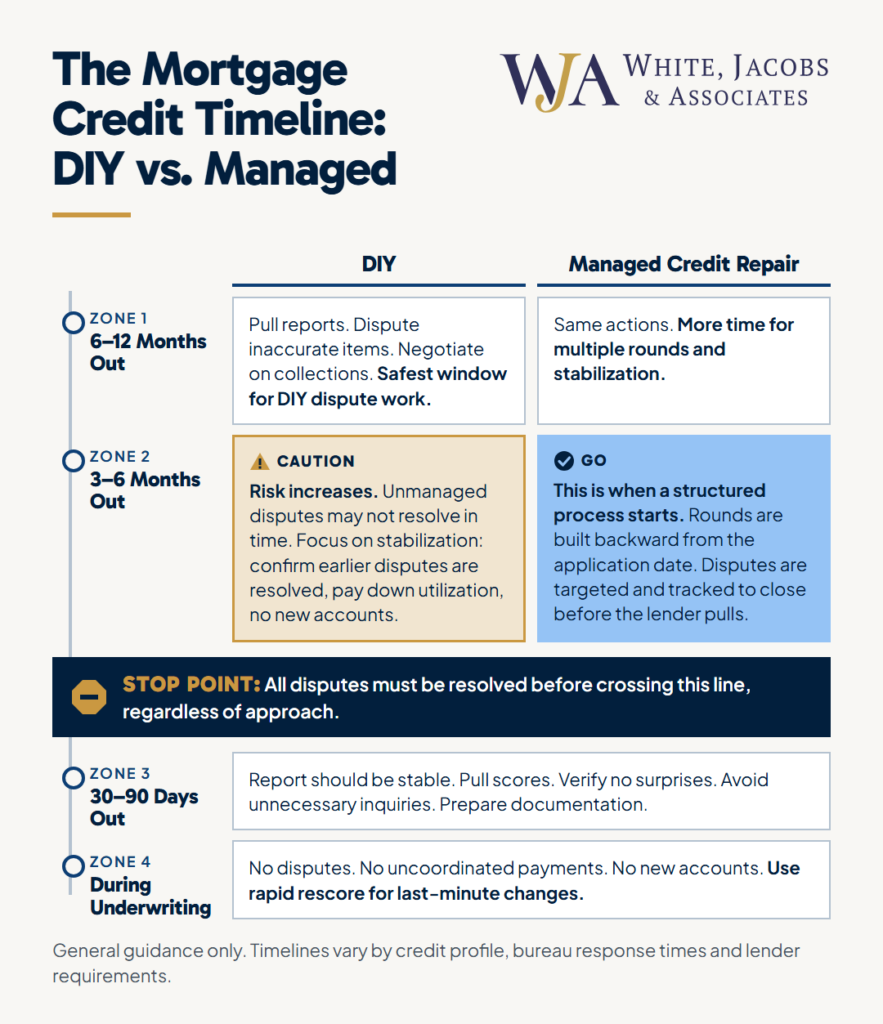
If You’re 6-12 Months Out
You have the most room to work with. Pull your reports from AnnualCreditReport.com, identify every derogatory item, and figure out what’s accurate and what isn’t.
Dispute anything inaccurate: wrong dates, wrong balances, accounts that aren’t yours, collections with a re-aged date of first delinquency. This is the window for challenging items through the bureaus and directly with furnishers. It’s also the window for negotiating on collections, whether that means settlement, payment in exchange for removal, or simply verifying that the collector can validate the debt.
At this distance, you have time for multiple rounds of disputes and for the report to stabilize after corrections land. If you’re doing this on your own, this is the safest window to work in because any open disputes have months to resolve before a lender ever sees your file. For a deeper look at what can actually be removed from your credit report, we’ve covered that separately.
If You’re 3-6 Months Out
This is the window where how you do credit repair matters as much as what you’re disputing.
If you’re handling disputes on your own, this is where the risk increases. An unmanaged dispute filed 4 months before a mortgage application may not resolve in time. If the dispute is still active when the lender pulls your report, you’re looking at the underwriting collision described above. For DIY disputes, this window is better spent on stabilization: confirm that any earlier disputes are resolved, check all three bureau reports for lingering “in dispute” notations, and focus on utilization rather than new challenges.
If you’re working with a credit repair firm that understands mortgage timelines, 3 to 6 months is when the process should be starting, not stopping. A structured program can run targeted dispute rounds, track resolution timelines, and close out all active disputes before your application date. The key is that the firm knows your target date from day one and builds the work backward from it. That’s different from filing disputes and hoping they resolve in time.
Regardless of approach, this is also when to pay down revolving balances strategically. Credit utilization makes up 30% of your FICO score, and it’s the fastest factor to move. Target getting your revolving utilization under 30%, and ideally under 10%. But timing matters: creditors report balances to the bureaus once per billing cycle, usually around your statement closing date. If you pay down a card on the 15th and your statement closes on the 20th, the lower balance should report within that cycle. If you pay on the 22nd, you may have to wait until the next cycle for the lower balance to show up.
Don’t open new accounts. Don’t close old ones (closing accounts reduces your available credit and can spike utilization). And don’t co-sign anything, because that adds a new tradeline and a new monthly payment to your debt-to-income ratio.
30-90 Days Before Applying
By this point, all dispute work should be complete, whether you handled it yourself or worked with a firm. The report should be stable with no active “in dispute” notations on any tradeline. If any remain, resolve them now, not after you’ve started the mortgage application.
Pull your scores to set a benchmark. The Experian app gives you a free FICO 8. Discover’s Credit Scorecard gives you a TransUnion FICO 8. Neither of these is the exact mortgage FICO, but they’re closer than VantageScore. For the actual FICO 2/4/5, myFICO.com is the only consumer-facing source.
Verify that nothing new has appeared on your report. No reinstated items, no surprise collections, no old accounts that have reappeared. Have documentation ready for anything a lender might question: proof of paid accounts, settlement letters, letters from creditors confirming corrections.
Avoid unnecessary hard inquiries. Don’t apply for new credit cards, store financing, or auto loans. The mortgage inquiry itself is fine, and rate shopping within a 14- to 45-day window is treated as a single inquiry by FICO. But other types of credit applications during this window can introduce risk for a few points you don’t need to lose.
During Underwriting: What Not to Do
Once you’ve applied and the lender is processing your file, the rules change. This is the phase where the wrong move can cost you the deal.
Don’t file any new disputes. Active disputes during underwriting can freeze your file or trigger a manual underwriting downgrade. If there’s something on your report that needs attention, talk to your loan officer first. They may be able to address it through a rapid rescore rather than a formal dispute.
Don’t pay off collections without talking to your lender. Paying a collection changes the account status but may not move the mortgage FICO. Under FICO 8 and the older mortgage FICO models, paid collections still count against your score. A lender who knows the file can advise whether paying a specific account will help, hurt, or make no difference.
Don’t open new accounts, close accounts, change jobs, or make large undocumented deposits. All of these introduce variables that underwriters have to verify and explain. Large deposits require a paper trail. Job changes require re-verification of income. New accounts change your credit profile. Any of these can delay closing.
If something needs to change during this phase, the tool your lender has is rapid rescoring. That’s the right channel for last-minute adjustments, not a credit bureau dispute.
How Rapid Rescoring Works (And Why You Can’t Do It Yourself)
Rapid rescoring is the one mechanism that bridges credit repair and the mortgage timeline. It’s also one of the most misunderstood tools in the process.
What a Rapid Rescore Actually Is
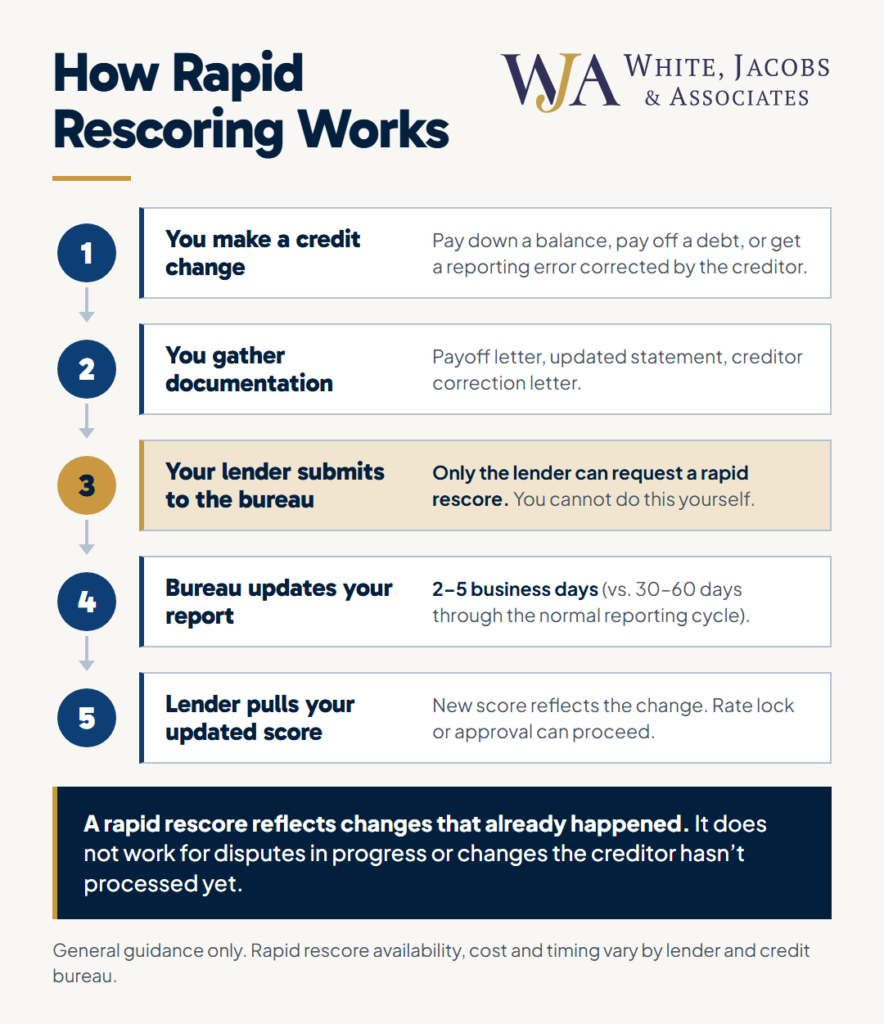
A rapid rescore is an expedited credit report update that your mortgage lender orders directly from the credit bureaus. Instead of waiting 30 to 60 days for a creditor’s updated information to flow through the normal reporting cycle, a rapid rescore gets the update reflected on your report in 2 to 5 business days.
Only your lender can request it. You cannot order a rapid rescore on your own, and no credit repair company can order one for you. The lender pays a fee to the bureau for the service.
What Qualifies for a Rapid Rescore
The change has to have already happened, and it has to be documentable. Qualifying changes include paid-off balances (with a payoff letter from the creditor), reduced balances (with an updated statement showing the new balance), corrected reporting errors (with a letter from the creditor confirming the correction), and removed collections (with documentation that the account has been deleted).
The key word is documentation. A rapid rescore isn’t a dispute. It doesn’t challenge anything. It takes a change that has already been made and processed by the creditor and accelerates how quickly that change appears on your credit report.
When to Use It and When It Won’t Help
Rapid rescoring works when you’ve made a specific, documented change and need the report to reflect it before the lender’s timeline runs out. The most common scenario: you paid down a credit card balance to lower your utilization, the creditor hasn’t reported the new balance yet, and your lender needs the updated score to lock your rate or finalize approval.
It does not work for disputes still in progress, items that haven’t been corrected by the creditor yet, or changes the creditor hasn’t processed. A rapid rescore is a reporting accelerator, not a score booster. It reflects reality faster. It doesn’t change reality.
Common Questions
Should I pay off collections before applying for a mortgage?
It depends on the scoring model and the specific situation. The mortgage FICO models (2/4/5) and FICO 8 still count paid collections against your score. Paying a collection changes the status from unpaid to paid, but the negative mark remains and the score impact under these models may be minimal. In some cases, negotiating for removal of the tradeline rather than just payment is a better strategy. If you’re already in the mortgage process, coordinate with your lender before paying anything, because the timing and reporting consequences matter.
How long should I wait after credit repair to apply for a mortgage?
All disputes need to be resolved and off your report before the lender pulls your credit. If you’re handling disputes on your own, finishing at least 60 to 90 days before you apply gives the report time to stabilize. If you’re working with a credit repair firm that builds the process around your mortgage timeline, starting 3 to 6 months out can work, because the dispute rounds are structured to close out before your application date. The critical thing is that no “in dispute” notations are on the report when the lender sees it.
Can I do credit repair during the mortgage process?
You can, but it’s risky. Active disputes during underwriting can freeze your file, trigger a manual underwriting downgrade (especially on FHA loans with disputed accounts over $1,000), or force you to withdraw the disputes, which can drop your score. The safest approach is to complete dispute work before you apply and save any remaining items for after you close. If something urgent surfaces during the process, work through your lender and their rapid rescore process rather than filing a new dispute.
What credit score do I need for a mortgage?
Minimums vary by loan type. FHA requires a 580 with 3.5% down (or 500 with 10% down). Conventional loans typically require a 620. VA and USDA loans have no official FICO minimum, but most lenders set their own floor at 620 to 640. These minimums get you through the door, but the pricing tier your score falls in determines what you actually pay in rate and points. A 621 and a 739 both qualify for a conventional loan, but they’re in very different pricing tiers.
Will my lender tell me what to fix on my credit report?
Some will. A good loan officer will identify the specific items affecting your approval or pricing and may suggest targeted actions, like paying down a specific card to lower utilization or paying off a small balance to improve your profile. But lenders can’t file disputes on your behalf, and their advice is focused on getting the file through underwriting, not on long-term credit strategy. If the work involves multiple tradelines across bureaus, inaccurate reporting, or items that need to be challenged through the FCRA process, that’s where working with a credit analyst who understands mortgage timelines fills the gap.
Get the Timing Right Before You Start
The difference between credit repair that helps your mortgage and credit repair that delays it comes down to sequencing. Fix the right items, at the right time, in the right order, and stop before the application stage begins. The credit repair work and the mortgage process are both moving timelines, and keeping them from colliding is the thing that makes it all work.
When our analysts work with a mortgage-track client, the first question is always “when do you want to apply?” Whether that’s 3 months out or 12, the answer shapes every decision that follows: what to dispute, how to structure the rounds, what to pay down, and when to stop. Starting the credit repair process with the application date in mind is the difference between a clean file at closing and a dispute notation that holds everything up.
Book a free consultation. We’re easy to talk to.