
Your credit affects your insurance rates. You’ve probably heard that before. But the score your insurer uses isn’t your FICO. It isn’t the VantageScore you see on Credit Karma. It’s a credit-based insurance score, a completely separate number generated by a completely different model, and you can’t check it on any free app or website. It’s built from the same credit report data that generates the score you can see, but it weighs that data differently and exists for a different purpose.

About 95% of auto insurers and 85% of homeowners insurers use some version of this score, according to the National Association of Insurance Commissioners. It reads your credit report, runs the data through a proprietary formula, and outputs a number that directly affects your premium. If your credit report has errors, those errors aren’t just pulling down your lending score. They’re inflating a number you’ve never seen, attached to a bill you’re already paying.
When our analysts review a client’s credit report, the insurance implications are part of what they evaluate. Not because we set insurance rates, but because the same report errors that affect a lending score are silently driving up auto and homeowners premiums through a different scoring system. Fixing the underlying report data fixes what feeds all of these systems at once.
What a Credit-Based Insurance Score Actually Is
The insurance industry has been using credit data in pricing decisions for decades. Understanding what this score is and what it isn’t matters if you want to know why your premiums are what they are.
Not Your FICO. Not Your VantageScore.
Credit-based insurance scores are proprietary models designed to predict one thing: how likely you are to file a claim. That’s different from a lending score, which predicts how likely you are to repay a debt. The models are built for a different purpose, trained on different outcome data, and weighted differently even though they read the same credit report.
The major insurance scoring models include LexisNexis Attract (scored on a 200 to 997 scale), TransUnion CreditVision, and FICO’s insurance-specific score. Your insurer is not required to tell you which model they use. Most consumers have no idea these scores exist, which is part of the problem. You know what a 720 FICO means for a mortgage rate. You have no equivalent reference point for what your insurance score means for your premium.
If you’ve ever wondered why your credit score looks different everywhere you check, this is one more layer. It’s not just that FICO and VantageScore produce different numbers from the same data. Your insurer is running yet another model on that same data and getting yet another number, one you never see.
Why Insurers Use Credit Data to Price Risk
The actuarial rationale dates back to a 2007 FTC study that found credit-based insurance scores correlate with claim frequency and severity. People with lower credit-based insurance scores file more claims, on average, than people with higher scores. The insurance industry uses this correlation as the basis for pricing.
Consumer advocates push back on this, and their argument is worth hearing. Correlation isn’t causation. The FTC’s own study found that the practice has a disproportionate effect on minority and lower-income consumers. Critics argue that credit problems are more likely to reflect life circumstances (job loss, medical bills, divorce) than any inherent claim risk, and that using credit data in insurance pricing penalizes people who are already financially stressed.
Both perspectives matter. What matters most for this article is the mechanical reality: whether you agree with the practice or not, if you live in one of the 46 states where it’s legal, your credit report data is actively influencing what you pay for auto and homeowners insurance right now.
Same Credit Report, Different Formula
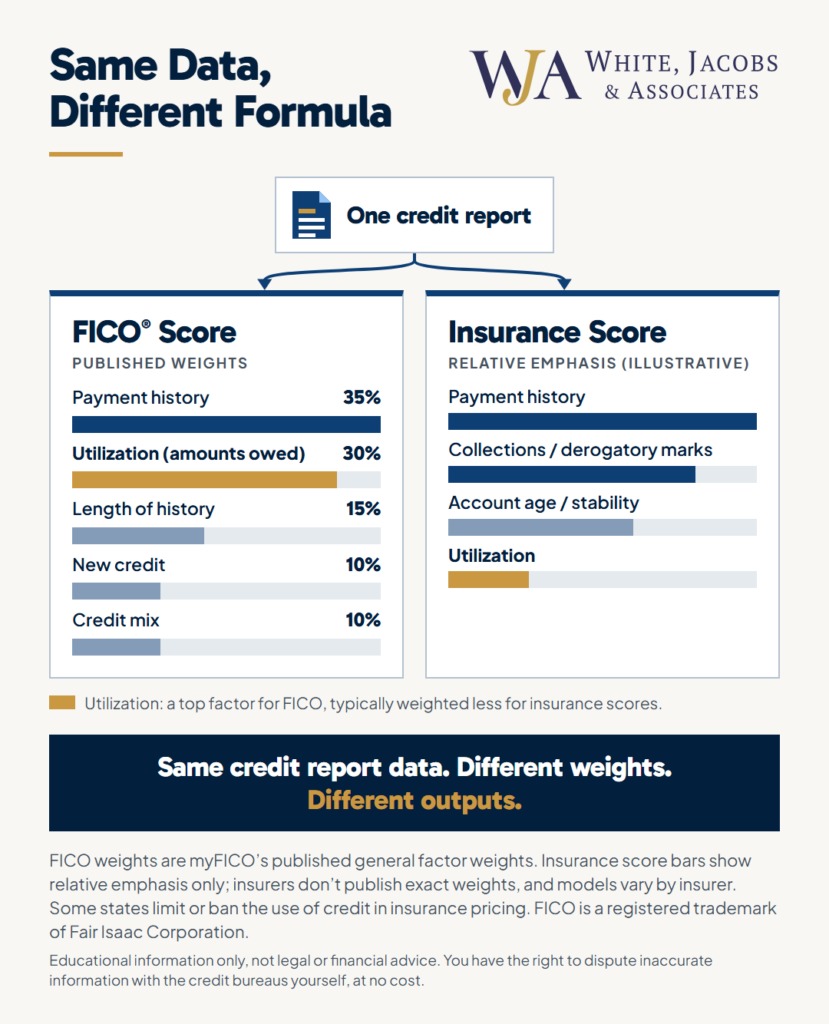
Your FICO score and your credit-based insurance score are both built from the data on your credit report. Same tradelines. Same payment history. Same balances, account ages, and derogatory marks. But the formulas weight that data very differently, which means the same credit report can produce a strong lending score and a weak insurance score at the same time.
What Both Scores Pull from Your Credit Report
The raw inputs are the same across both systems: payment history, outstanding debt, length of credit history, recent credit inquiries, credit mix, and derogatory marks (collections, charge-offs, bankruptcies). Both FICO and the insurance scoring models read these data points from your Experian, Equifax, and TransUnion files.
This is why a credit report error doesn’t stay contained to one score. If a creditor reports a wrong balance, a late payment that didn’t happen, or a collection that isn’t yours, that bad data feeds into every model that reads the report. Your FICO takes a hit, your insurance score takes a hit, and if you’re applying for a mortgage, your DTI calculation takes a hit too because lenders pull payment data from the same report. One error can create penalties across multiple systems you may not even know are reading your file.
Where the Weights Diverge
FICO publishes its five-category breakdown. Payment history is 35% of your score. Amounts owed (which includes utilization) is 30%. Length of history is 15%, new credit is 10%, and credit mix is 10%. Those weights are well documented and widely understood.
Insurance scoring models don’t publish their weights the same way. The formulas are proprietary, and no insurance scoring company has released a percentage breakdown comparable to FICO’s. But based on what the scoring companies, the NAIC, and TransUnion have disclosed about the factors these models emphasize, the directional differences are consistent enough to be useful. The emphasis shifts in a few important directions.
Payment patterns carry more weight. The frequency and recency of late payments matter more in insurance scoring than the 35% FICO gives them. A single recent late payment, particularly one reported in the last 12 to 24 months, can move an insurance score harder than it moves your FICO.
Collections and charge-offs carry more weight. In newer FICO models (FICO 9, FICO 10), paid collections are de-emphasized or ignored entirely. Insurance scoring models don’t necessarily follow that trend. A collection account, even one that’s paid, may still significantly penalize your insurance score.
Utilization carries less weight. Utilization (your revolving balances relative to your credit limits) makes up roughly 30% of your FICO score. Insurance models care about it, but not nearly as much. Paying down a credit card from 80% utilization to 10% might boost your FICO by 50 or more points while producing a much smaller movement in your insurance score.
Account age and stability carry more weight. A longer credit history gives insurance models more data to work with, and they reward it. Thin files and recently opened accounts are treated as higher risk in insurance scoring, even if the FICO impact is more moderate.
The practical result: the actions that improve your FICO the fastest (paying down cards) may not be the actions that improve your insurance score the fastest (resolving collections, correcting late payment reporting, building account history).
Why This Creates a Blind Spot
You can check your FICO for free through the Experian app. You can pull your VantageScore from Credit Karma or Discover’s Credit Scorecard. But there is no consumer-facing app that shows your credit-based insurance score. LexisNexis Attract, TransUnion CreditVision, and other insurance models are not available for you to monitor the way lending scores are.
You can’t watch this score move when you dispute an error. You can’t see what it was before a correction and what it is after. The only part of the equation you can control is the accuracy of the credit report data that feeds it. If the data going into the model is wrong, the output is wrong. And you’ll never know it’s wrong because you can’t see the output. You’ll just keep paying a premium that’s higher than it should be.
What a Credit Report Error Actually Costs You in Insurance
The premium gap between good credit and poor credit isn’t a rounding error. It’s thousands of dollars a year, and the data supporting it comes from large-scale studies, not estimates.
Auto Insurance
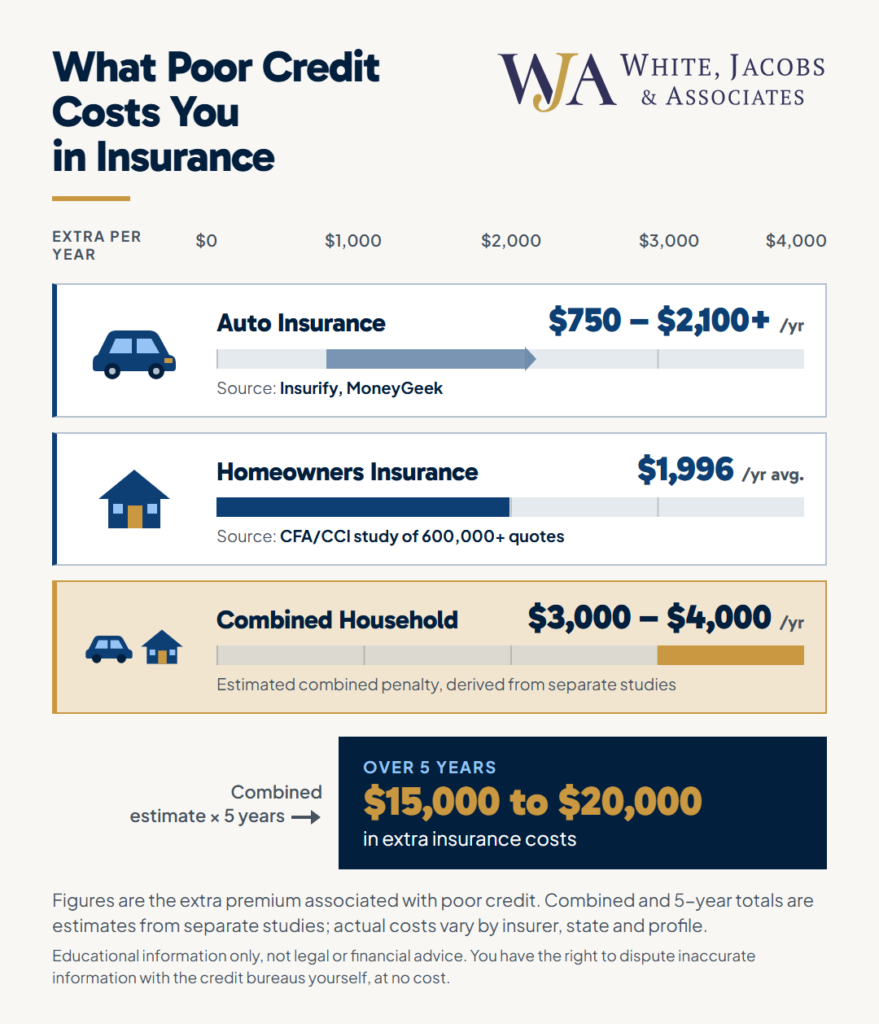
An Insurify analysis of 2026 rate data found that drivers with poor credit (below 580) pay roughly 40% more for full-coverage auto insurance than drivers with excellent credit (above 720). Nationally, that’s about $750 per year in extra premium.
In many states, the gap is much wider. A MoneyGeek analysis using Quadrant Information Services rate data found the national average credit penalty is $2,102 per year, with 30 states exceeding $2,000. In Wyoming, it’s $2,876. In D.C., it’s $2,756. In Texas, $2,712. MoneyGeek’s headline finding: in many states, having poor credit costs more than having a DUI on your driving record.
That comparison should put the scale of this into perspective. A DUI is a serious driving infraction with a direct connection to insurance risk. Poor credit has no direct connection to your driving. But the premium penalty can be larger.
Homeowners Insurance
A study by the Consumer Federation of America and the Climate and Community Institute, based on over 600,000 test quotes nationwide, found that homeowners with credit scores around 630 pay an average of $1,996 per year more than homeowners with credit around 820 who are otherwise identical (same property, same location, same coverage).
In the worst states, the penalty is extreme. Oklahoma: $4,138 per year. Louisiana: $3,754. Arkansas: $3,083. In percentage terms, Pennsylvania homeowners with low credit pay 181% more than their high-credit neighbors. Arizona: 168%. Oregon: 154%.
The study also found that, on average, having low credit costs more in homeowners insurance than living in a high disaster-risk area. That’s the part that surprises people. Your credit report can matter more to your premium than whether you live in a flood zone.
The Combined Household Hit
Most households carry both auto and homeowners insurance. Based on the Insurify and CFA data, a household carrying both policies with credit-driven penalties could be looking at $3,000 to $4,000 per year in combined extra premium. These figures come from separate studies using different credit tier definitions and methodologies, so the combined range is a reasonable estimate rather than a single study’s finding. But the scale is clear: over five years, that’s $15,000 to $20,000 in extra insurance costs, paid on bills that arrive every month without any indication that a credit-based score is the reason they’re higher than they should be.
If even part of that penalty is driven by inaccurate credit report data rather than genuinely poor credit, it’s money you’re paying because of an error nobody told you about, in a scoring system you didn’t know existed.
The Credit Report Errors That Hurt Insurance Scores Most
Not all credit report errors affect your insurance score equally. Because the insurance models weight certain factors more heavily than FICO does, specific types of errors can have an outsized impact on what you’re paying for coverage.
Late Payment Reporting Errors
Insurance scores treat payment patterns as one of the strongest predictors of claim risk. A single incorrectly reported late payment, particularly a recent one, can move an insurance score more than it moves your FICO. A 30-day late that was actually paid on time, a 60-day late that should have been reported as 30, or a payment that was coded as missed during a billing dispute that has since been resolved. All of these are common credit reporting errors, and all of them hit insurance scores hard.
If the payment was actually made on time and the creditor reported it wrong, disputing the tradeline with the bureau corrects the data feeding both your lending score and your insurance score. The dispute process is the same either way.
Collections That Shouldn’t Be There
Collections are a major negative in insurance scoring, and the penalty may be larger than what you’d see in your FICO. Newer FICO models (FICO 9 and 10) have reduced the weight of paid collections or ignore them entirely. Insurance scoring models don’t necessarily follow that approach. A paid collection can still carry significant weight.
This creates a situation where a collection that barely affects your current FICO could be quietly dragging your insurance score down. If the collection is inaccurate, unverifiable, or re-aged (showing a more recent date of first delinquency than the original), it’s disputable under the FCRA. Removing it can have a larger impact on your insurance score than on the FICO you’ve been watching.
For a detailed breakdown of which items are actually removable, our guide on what can be removed from your credit report covers the full picture.
Account Status Errors
A closed account still reporting as open with an active balance. A settled debt showing as unpaid. An account that belongs to someone else appearing on your file. These status errors distort the pattern that insurance models are reading. Insurance scores focus on the overall shape of your credit profile: whether accounts are stable, whether derogatory marks are active or resolved, whether the trajectory is improving or declining. A status error that makes a resolved situation look like an ongoing one can weigh more heavily than you’d expect.
If a co-signed loan that defaulted is reporting inaccurately on your file, that’s an example of a status error that could be costing you in both your lending score and your insurance premiums at the same time.
The Multi-System Fix
The dispute process works the same regardless of which scoring system you’re trying to correct. You identify the inaccuracy, file a dispute with the bureau and the data furnisher under the FCRA, and the bureau has 30 days to investigate (extendable to 45 with supplemental documentation). If the item can’t be verified as accurate, it must be corrected or removed.
That correction doesn’t just fix your FICO. It flows into every scoring model that reads your credit report, including your VantageScore, your credit-based insurance score, and the payment data your mortgage lender uses to calculate your DTI. One dispute, one investigation, one correction, and the accurate data propagates across all of these systems. This is the advantage of fixing the data at the source rather than trying to manage each system individually.
When our Investigative Research team structures a dispute strategy for a client, the goal is accuracy on the underlying report. That accuracy reaches every system reading the data, including systems the client never knew existed. You can learn more about how our process works.
How to Check What’s Feeding Your Insurance Score
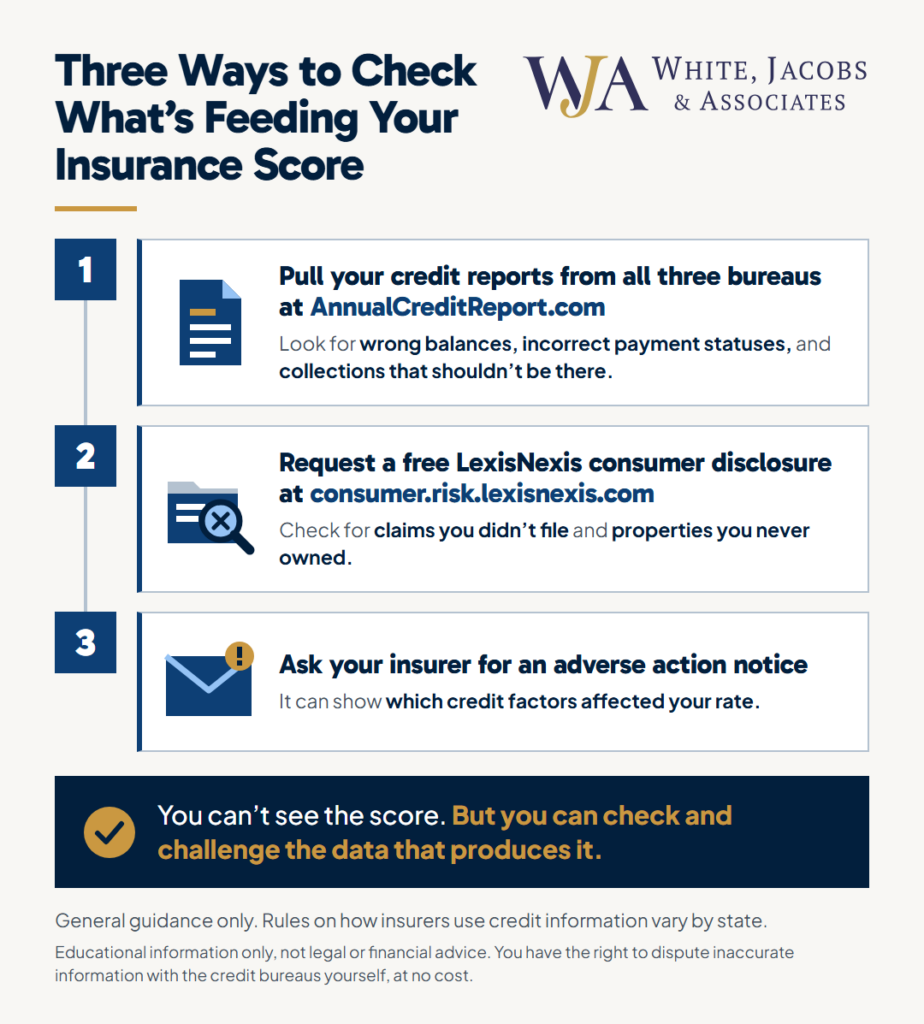
You can’t see the score itself. But you can see the data that produces it, and you can challenge anything inaccurate. Here’s what you can actually do.
Start with Your Credit Report
Pull your reports from all three bureaus at AnnualCreditReport.com. You’re entitled to free weekly reports from each bureau. Look for the same things you’d look for before a loan application: wrong balances, incorrect payment statuses, accounts that aren’t yours, collections that are inaccurate or unverifiable. Every error on this report is feeding your insurance score, whether you know it or not.
Pay particular attention to payment history and collections, since those carry more weight in insurance scoring than in FICO. A wrong balance might cost you 20 FICO points through inflated utilization but barely touch your insurance score. A falsely reported late payment might have the opposite effect.
Request a LexisNexis Consumer Disclosure
Separately from your credit report, LexisNexis maintains the CLUE database (Comprehensive Loss Underwriting Exchange), which tracks your insurance claims history for seven years. Insurers check this alongside your credit-based score when pricing your policy.
You can request a free disclosure once per year at consumer.risk.lexisnexis.com. This won’t show your insurance score, but it will show the claims data insurers see. Check it for errors: claims attributed to you that you didn’t file, properties you never owned, vehicles you never drove. Even calling an insurer to ask about a potential claim can create an entry on this report, which means inquiries you didn’t think twice about could be affecting your premiums.
Ask for an Adverse Action Notice
If you believe your credit data affected your insurance premium, ask your insurer directly. Under federal law, if an insurer uses credit information and it results in a less favorable rate, they’re required to provide an adverse action notice that identifies the key factors behind the decision.
This notice won’t tell you your score. But it will tell you which credit factors are pulling your rate up. That’s useful information. If the notice cites “derogatory marks” and you know there’s an inaccurate collection on your report, you’ve just confirmed the connection between the report error and your premium. That gives you a specific target for a dispute.
States Where This Doesn’t Apply
A handful of states ban or restrict the use of credit-based insurance scoring.
Auto insurance bans: California, Hawaii, Massachusetts, and Michigan prohibit insurers from using credit data to set auto insurance premiums.
Homeowners insurance bans: California, Maryland, and Massachusetts prohibit insurers from using credit data for homeowners insurance pricing.
For the other 46 states and Washington, D.C., credit-based insurance scoring is legal and widely used. Several states have introduced legislation to limit or ban the practice (Illinois, New York, Iowa, Missouri, Oklahoma, and West Virginia have all seen bills in recent sessions), and the federal PAID Act has been introduced in Congress but hasn’t passed. For now, unless you live in one of the ban states, your credit report is factoring into your insurance costs.
If you’re in Texas (where the average credit penalty is $2,712/year for auto insurance according to MoneyGeek), this is especially relevant.
Common Questions
Does my credit score directly determine my insurance rate?
Not your FICO or VantageScore. Insurers use a credit-based insurance score built from the same credit report data but calculated with a different formula designed to predict claims, not loan repayment. You can’t see this score through any free consumer app. The credit report data is the link between the two systems. Errors in the report affect both scores simultaneously, even though the impact may not be proportional.
Will improving my credit lower my insurance?
In most cases, yes, because improving your credit means improving the underlying report data that feeds both your FICO and your insurance score. But the actions that matter most are different for each score. Paying down a credit card balance can significantly improve your FICO (utilization is 30% of the score) while producing a smaller movement in your insurance score (which gives more weight to payment history and derogatory marks). The changes that tend to move insurance scores most are resolving collections, correcting late payment errors, and building longer account history.
Can I check my credit-based insurance score?
Not through any free consumer app. LexisNexis Attract, TransUnion CreditVision, and other insurance-specific models are proprietary and not available for consumer self-monitoring. You can check the underlying credit report data that feeds the score (at AnnualCreditReport.com), and you can check your claims history (through LexisNexis consumer disclosure), but the insurance score itself is not consumer-accessible.
How is this different from a CLUE report?
A CLUE report tracks your insurance claims history: what claims were filed, when, and for how much. It’s maintained by LexisNexis and covers seven years. A credit-based insurance score is derived from your credit report data: payment history, balances, account ages, derogatory marks. Insurers may use both when setting your premium. Errors in either one can inflate what you pay, and you can dispute errors in both. But they’re separate reports tracking different information.
If I fix an error on my credit report, will my insurance rate automatically go down?
Not automatically. The corrected data feeds into your insurance score the next time your insurer pulls your credit report, which typically happens at policy renewal. Some insurers re-score annually, others at different intervals. After correcting a credit report error, you can ask your insurer for a re-rate or shop your policy with competing carriers. Re-shopping after a credit correction is one of the most effective ways to capture the savings, because your current insurer may not re-pull your credit until renewal while a new insurer will pull it as part of the quote process.
Your Credit Report Is Running Up More Bills Than You Think
Most people check their credit report when they’re about to apply for a loan. That makes sense. But the report isn’t sitting idle the rest of the time. It’s feeding the FICO score that determines your interest rates. It’s feeding the DTI calculation your mortgage lender runs. And it’s feeding the insurance score that sets what you pay for auto and homeowners coverage every single month.
A credit report error doesn’t stay in one lane. It crosses into every system that reads the file. An inaccurate collection doesn’t just cost you points on your FICO. It inflates your DTI through a phantom payment, and it drags down an insurance score that’s adding hundreds or thousands to your annual premiums, all from the same piece of bad data.
Most of those penalties are invisible until you look. The DTI penalty shows up when a lender declines your mortgage application. The insurance penalty never shows up at all, because there’s no app that tells you your insurance score dropped, and there’s no line item on your premium statement that says “credit surcharge.”
When our analysts review a client’s report, they’re looking at the data that feeds all of it. Not just the score-affecting items, but the payment data that inflates DTI, the derogatory marks that drag insurance scores, and the account-level errors that distort every model reading the file. Getting the report right is the one correction that reaches every system at once.
Book a free consultation. We’re easy to talk to.