
Hard inquiries are one of the most worried-about topics in credit. They’re also one of the least damaging things that can happen to your score. A single hard inquiry typically costs fewer than five points on your FICO score. It stops affecting your score after 12 months and falls off your report entirely after two years. For comparison, a single late payment can drop your score by 100 points or more and stays on your report for seven years.
If you’re spending energy worrying about hard inquiries while your credit report has late payments, collections, or charge-offs on it, you’re focused on the wrong thing. That’s not opinion. It’s what the scoring data shows, and it’s what our analysts tell clients almost every week.
There are a few specific situations where inquiries genuinely matter, and we’ll cover those. But for most people working on their credit, hard inquiries are a distraction from the items that are actually holding their score down.
How Much a Hard Inquiry Actually Costs You
Before you can put inquiries in perspective, you need to know what they actually do to your score. The numbers are smaller than most people expect.
The FICO Data on Inquiry Impact
According to FICO, a single hard inquiry typically lowers your score by fewer than five points. In many cases, the impact is even smaller than that, especially if you have a well-established credit history with multiple accounts.
Inquiries fall under the “new credit” category, which makes up 10% of your total FICO score. That 10% also includes new account openings, not just inquiries. So hard inquiries are sharing a small slice of the scoring pie with other factors.
The scoring impact lasts 12 months. After that, the inquiry is still visible on your credit report but no longer factors into your FICO calculation. At the 24-month mark, it drops off the report entirely. This is a self-correcting factor. You don’t need to do anything to make it go away.
Why FICO Includes Inquiries at All
If the impact is so small, why does FICO count inquiries? Because of what they can signal in aggregate.
FICO’s own data shows that consumers with six or more inquiries in a 12-month period are up to eight times more likely to declare bankruptcy than consumers with none. That’s the statistical pattern FICO is looking for: someone applying for credit repeatedly in a short window, which can be a sign of financial stress.
But that’s a correlation about patterns, not a verdict on any individual inquiry. One or two hard pulls for a mortgage or an auto loan aren’t the behavior that statistic describes. FICO built the rate-shopping deduplication rules specifically to account for normal comparison shopping. The model is watching for a pattern of escalating credit-seeking, not for someone shopping around for the best rate on a car.
What’s Actually Dragging Your Score Down (It’s Probably Not Inquiries)
The best way to understand how little inquiries matter is to compare them to the things that matter a lot.
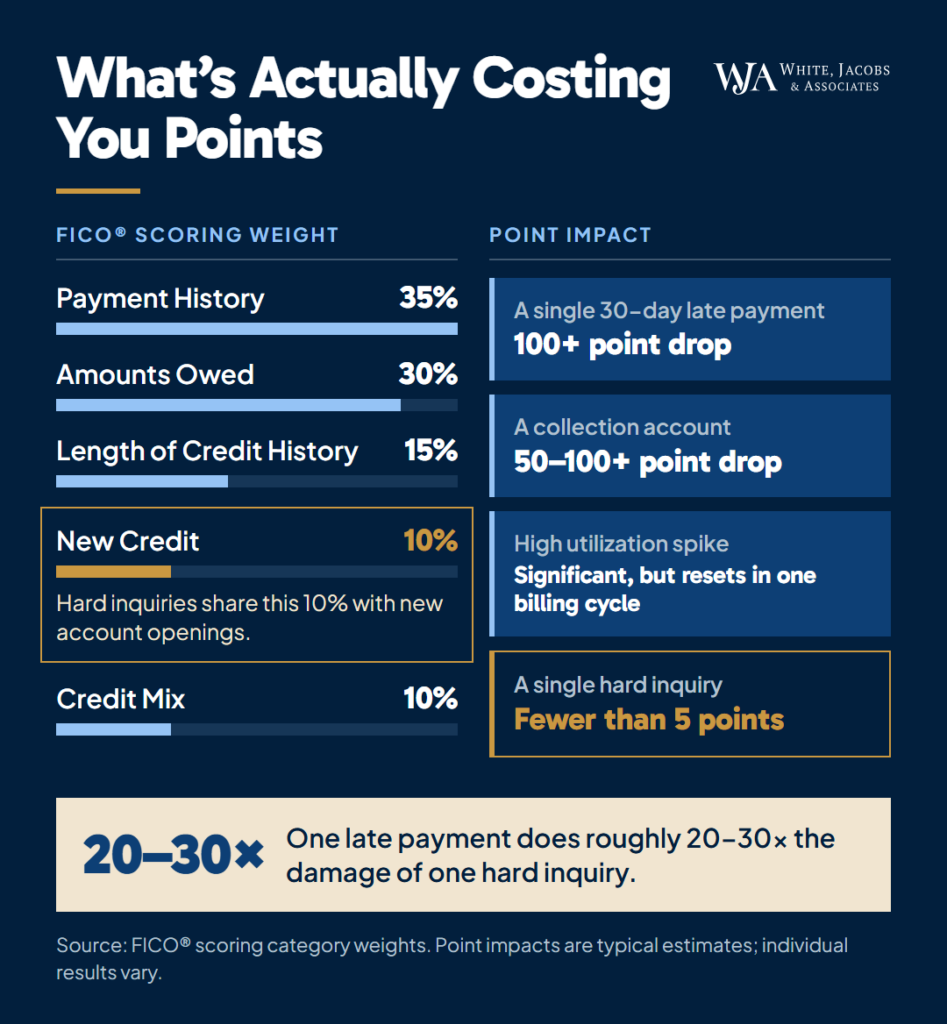
Payment History Is 3.5x More Important
Payment history makes up 35% of your FICO score. The entire “new credit” category, which includes inquiries, makes up 10%. That means payment history is weighted 3.5 times more heavily than the category inquiries belong to.
In practical terms: a single 30-day late payment on an otherwise clean credit profile can cause a score drop of 100 points or more. A single hard inquiry causes a drop of fewer than 5. One late payment does roughly 20 to 30 times the damage of one inquiry. If you’re watching your score drop and trying to figure out why, the answer is almost never “too many hard inquiries.”
A Collection Does More Damage Than 20 Inquiries
A collection account is classified as a severe derogatory mark. It can drop your score by 50 to 100 points or more depending on the rest of your profile. It stays on your report for seven years from the date of first delinquency. A hard inquiry, by comparison, costs fewer than 5 points and is gone in two years.
If you have a collection sitting on your report and you’re worried about hard inquiries, you’re looking past the item where a professional review can actually make a difference. Collections involve specific reporting requirements, and when those requirements aren’t met, there’s a basis for dispute. Inquiries don’t work that way. For a deeper look at what’s actually challengeable, our breakdown of what can be removed from your credit report covers the full picture.
Utilization Swings Can Dwarf Inquiry Impact
Credit utilization makes up 30% of your FICO score, three times the weight of the entire new credit category. If you run up a credit card to 80% of its limit before applying for a loan, that utilization spike does far more damage than the hard pull from the application itself.
The good news about utilization is that it has no memory. FICO looks at your current utilization snapshot, not your utilization history. Pay the balance down before your next statement closes, and the utilization damage resets in one billing cycle. That makes it the fastest scoring lever you can pull, and a far better use of your attention than worrying about whether a hard inquiry cost you 3 points.
How an Analyst Actually Reads a Credit Report
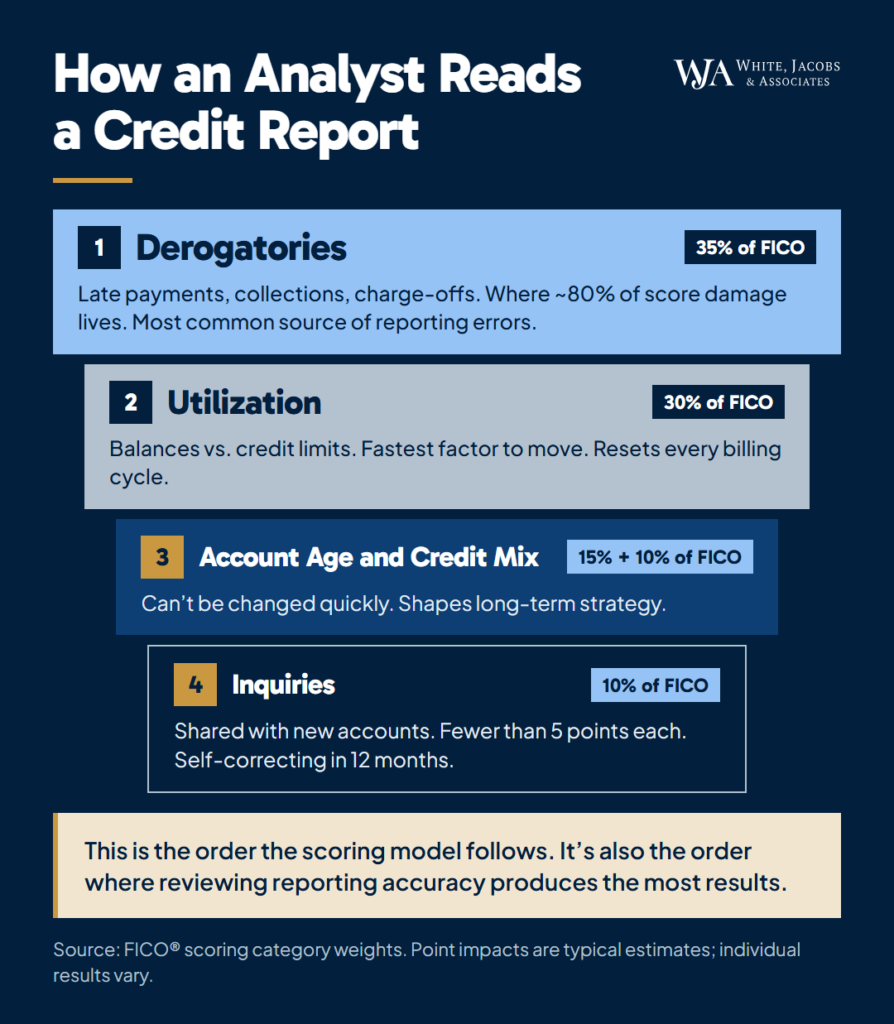
When our analysts pull a client’s report for the first time, they’re not looking at the inquiry section. They follow the same order the scoring model follows, because the weight structure tells you where the real damage lives.
Derogatories come first. Late payments, collections, charge-offs. This is where roughly 80% of the score damage sits for most people working on their credit, and it’s where inaccurate reporting is most common and most costly. A single misreported late payment or a collection with a wrong date of first delinquency can cost dozens of points.
Utilization comes second. It’s the fastest factor to move, and small changes in balances relative to credit limits can produce meaningful score movement within a single billing cycle.
Account age and credit mix come third. These can’t be changed quickly, but they shape the long-term strategy for how a client rebuilds.
Inquiries come last. They’re self-correcting, they carry the least weight, and they’re rarely worth spending time on while bigger items are still on the report. That priority order follows the FICO weight structure: 35%, 30%, 15%, 10%, 10%. It’s also the order in which a detailed review of reporting accuracy produces the most results, because errors in the heavier-weighted categories cost the most points. You can learn more about how our review process works.
The Three Situations Where Inquiries Actually Matter
Inquiries are usually overblown, but “usually” isn’t “always.” There are three specific situations where they can genuinely affect your outcome.
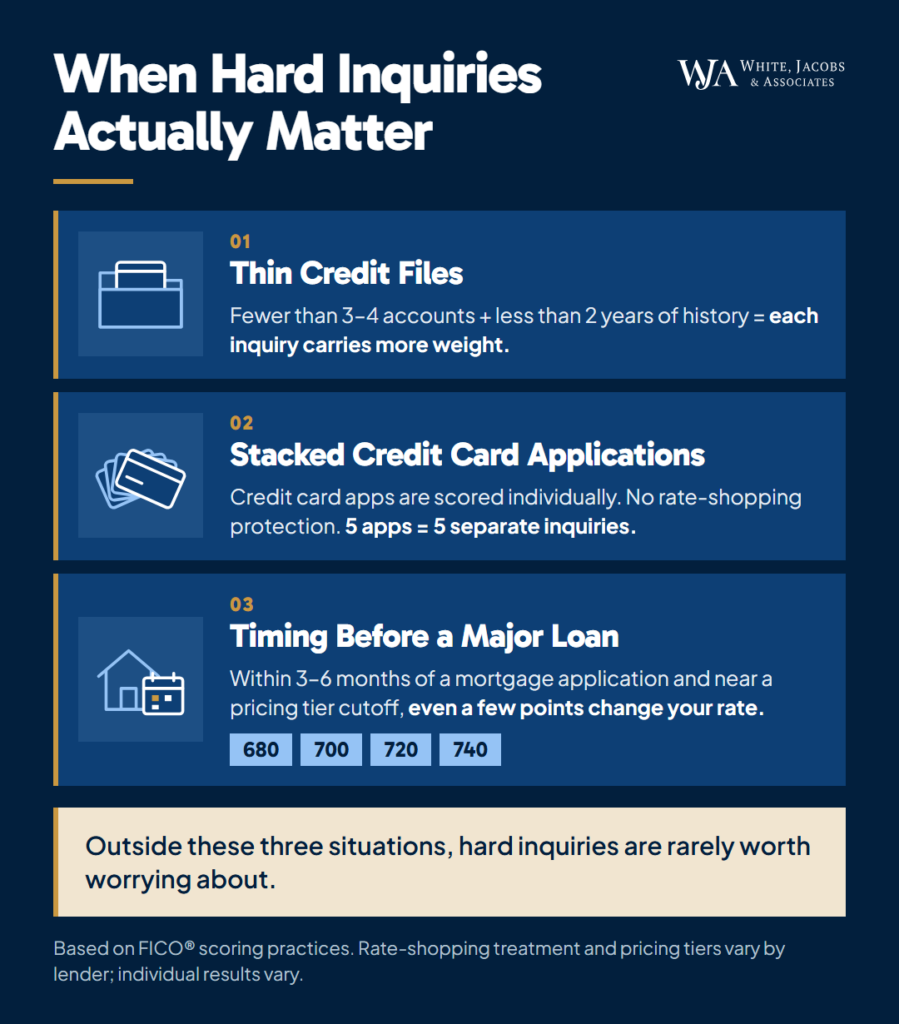
Thin Credit Files
If you have fewer than three or four accounts and less than two years of credit history, each inquiry carries more relative weight. The “new credit” category has less data to work with, so each signal in that category is amplified. For someone with 15 accounts and a decade of history, one inquiry is noise. For someone with two accounts and eight months of history, the same inquiry takes up more scoring real estate.
If you’re early in building credit, being selective about applications isn’t about paranoia. It’s about recognizing that every factor on a thin file matters more than it will once the file fills out.
Stacked Credit Card Applications
This is the one scenario where inquiries can genuinely stack up, because credit card applications don’t get rate-shopping protection. Unlike mortgage and auto loan inquiries, which are grouped into a single scoring event within a 14- to 45-day window, each credit card application counts as its own separate inquiry.
Five card applications in two months means five individually-scored inquiries. At fewer than 5 points each, that’s still not catastrophic, but 15 to 25 points can matter if you’re near a scoring threshold. The bigger concern with stacked card applications is usually the new accounts themselves, which lower your average account age, but the inquiries add to the picture.
Timing Before a Major Loan Application
If you’re three to six months away from applying for a mortgage and your score is sitting near a pricing tier cutoff (680, 700, 720, 740), even a few points can change what you pay. The difference between a 699 and a 701 on a conventional mortgage can mean a different loan-level price adjustment, which translates to real money over 30 years.
In this narrow window, avoiding unnecessary hard pulls is a reasonable precaution. Don’t open a new credit card, don’t apply for store financing, and time your credit moves strategically. Outside of that pre-application window, the concern isn’t worth the mental energy.
“The Dealership Pulled My Credit 10 Times”
This is the most common inquiry panic, and it’s almost always less damaging than it looks.
Why Those 10 Inquiries Probably Count as One
When you apply for financing at a dealership, the dealer typically submits your application to multiple lenders to find the best rate. Each lender pulls your credit, and each pull shows up as a separate inquiry entry on your report. Leaving a dealership with 8 to 12 inquiry entries from different lenders is normal.
But under FICO’s rate-shopping rules, all auto loan inquiries within a 45-day window (FICO 8 and newer) or a 14-day window (older FICO models) are scored as a single inquiry. The entries stay on your report individually because each lender did pull your credit, but the scoring model treats them as one event. Those 10 entries are doing the damage of one inquiry, not ten.
When Dealership Inquiries Cross the Line
If the dealer pulled your credit without your authorization (before you signed a credit application, after you explicitly said no, or for a transaction that never moved forward), that’s a permissible purpose issue under the FCRA. Unauthorized inquiries can be disputed with the credit bureaus.
Authorized multi-lender pulls are a different story. Even if you didn’t realize the dealer would submit to that many lenders, the pulls are legitimate if you signed a credit application. They’ll age off your report in 24 months and stop affecting your score in 12. The rate-shopping deduplication means the scoring impact was minimal from day one.
What You Can and Can’t Do About Inquiries on Your Report
Unauthorized Inquiries Are Disputable
If a company pulled your credit without your permission, you have the right to dispute that inquiry directly with the credit bureaus and with the company that made the pull. This covers identity theft-related pulls, companies you never applied to, and pulls that should have been soft inquiries (like an employer background check or a prequalification that was processed as a hard pull instead).
Legitimate Inquiries Are Not Removable Through Disputes
If you applied for a credit card, submitted a loan application, or authorized a dealer to shop your application to lenders, the resulting inquiries are legitimate. They will fall off your report in 24 months and stop affecting your score in 12. No dispute process will remove them early.
Companies that promise to remove legitimate hard inquiries are making a promise the system doesn’t support. Consumers can dispute inaccurate information on their credit reports at no cost through each bureau. An inquiry that resulted from a real application isn’t inaccurate.
The Real Question: Should You Even Be Spending Time on This?
If you have late payments, collections, or charge-offs on your report, every hour spent worrying about inquiries is an hour not spent on the items that are costing you 10 to 50 times more points. The derogatory items are where reporting errors are most common, where disputes can produce real movement, and where the score impact justifies the effort.
Fix the big items first. The inquiries will handle themselves. If you’re not sure where to start, our analysts can walk you through what’s on your report and help you separate what’s worth addressing from what just needs time.
Common Questions
Do soft inquiries affect my credit score?
No. Soft inquiries have zero effect on your credit score. Checking your own credit, prequalification checks from lenders, employer background checks, and account reviews by your existing creditors are all classified as soft inquiries. You can check your own credit daily and it will never cost you a point. Only hard inquiries, which result from credit applications you initiate, affect your score.
How many hard inquiries is too many?
There’s no fixed cutoff. FICO’s data shows a correlation between six or more inquiries in a 12-month period and higher bankruptcy risk, but the scoring impact of each individual inquiry is still small. The more relevant concern is what those inquiries represent. If you’re applying for multiple credit cards in a short period, the new accounts themselves (lower average age, higher available credit) typically affect your score more than the inquiry entries do.
Will rate shopping for a mortgage hurt my credit?
Not if you do it within a reasonable window. FICO 8 and newer models treat all mortgage inquiries within a 45-day period as a single inquiry. Older FICO models use a 14-day window. FICO also ignores mortgage inquiries from the 30 days immediately before scoring, giving you a built-in buffer. Get your rate comparisons done within a few weeks and the total inquiry impact is the same as a single pull.
How long do hard inquiries stay on my credit report?
Hard inquiries remain visible on your credit report for 24 months. They only affect your FICO score for the first 12 months. After a year, an inquiry is still listed on your report but is no longer factored into the score calculation. After two years, it disappears from the report entirely. No action is required to make this happen.
Can a credit repair company remove hard inquiries?
Only unauthorized inquiries can be legitimately disputed and removed. If you applied for the credit, the inquiry is accurate and will stay on your report until it ages off after 24 months. Any company that guarantees removal of legitimate inquiries is promising something the dispute process doesn’t support. For a full breakdown of what types of credit report entries can and can’t be challenged, see our guide on what can actually be removed from your credit report.
Focus on What Moves the Needle
Hard inquiries handle themselves. They fade in 12 months and disappear in 24. The items that stick around for seven years, the late payments, collections, charge-offs, and accounts reporting inaccurate information, are the ones that cost you real money through higher interest rates and denied applications. Those are the entries where a detailed review of what’s accurate versus what’s disputable can change the math.
When our analysts sit down with a client for the first time, the conversation starts with those items. What’s dragging the score down, what’s potentially inaccurate, and what a realistic timeline to improvement looks like. The inquiries barely come up. That’s not because we ignore them. It’s because there are almost always bigger problems to solve first, and solving those problems is what actually moves the score.
Book a free consultation. We’re easy to talk to.